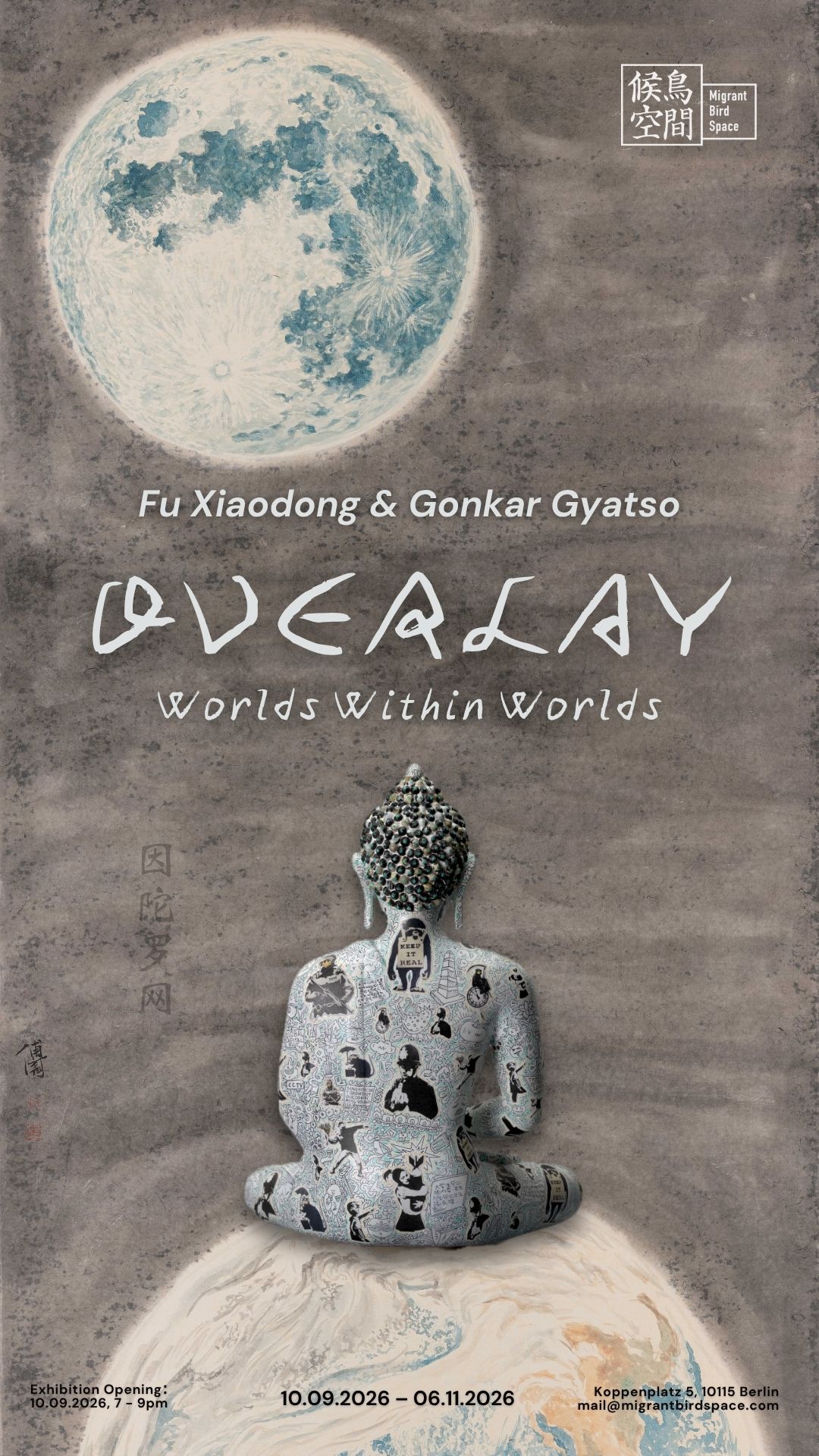
We rarely inhabit a single system of knowledge. Ancient cosmologies, religious beliefs, scientific models, art history, popular culture and the continuous flow of digital information coexist within contemporary consciousness. Overlay — Worlds Within Worlds brings together Gonkar Gyatso and Fu Xiaodong, two artists whose works make this coexistence visible. Rather than treating tradition and the present as separate territories, the exhibition asks how different systems of seeing can remain active within the same image—and within the same mind.
Fu Xiaodong’s works move across strikingly different territories. The River Map and the Luo Script returns to one of the oldest cosmological structures in Chinese thought, while Solar System turns toward a modern scientific image of the universe. Her Persian Garden series emerged from encounters with Pompeii and historical sites across Eastern Europe and Central Asia, bringing other civilizations and spatial traditions into her pictorial world. These subjects are not presented as separate bodies of knowledge. In Fu’s paintings, they enter the same fluid field of perception.
This is fundamental to her approach to ink painting. Classical Chinese landscape was never simply a representation of visible scenery; it proposed relationships between human beings, nature, time and the larger order of existence. Fu retains this capacity while allowing its structure to absorb contemporary experience. Perspective shifts, spaces unfold without a single fixed viewpoint, and fragments accumulate through movement, memory and observation. Her paintings suggest that an inherited way of seeing can remain alive precisely because it is capable of encountering what lies beyond itself.
Gonkar Gyatso approaches this condition through Buddhist iconography. Buddha and Tara remain immediately recognisable in works such as Buddha Isn’t Smiling and Grey Tara, yet their bodies are penetrated by another visual universe: stickers, logos, cartoons, celebrities, consumer imagery and fragments of global popular culture. The sacred image does not disappear beneath this accumulation. It persists through it.
In Paying Tribute to the Masters, this process extends into contemporary art history itself. The Buddha becomes a surface upon which different cultural references and artistic languages can meet. Gyatso’s images therefore resist the idea of cultural purity. Identity is shown as something continuously formed through encounter, displacement, memory and adaptation.
The two artists work from very different histories, yet their works converge around a shared proposition: a worldview does not necessarily vanish when another is placed over it. The older structure may remain underneath, altering the meaning of what comes later, while being transformed by it in return.
Overlay refers to this simultaneous presence. A Buddhist figure can contain the visual noise of global consumer culture; an ink painting can move between ancient Chinese cosmology, the solar system and a Persian garden. These worlds do not need to resolve into one. The capacity to perceive their relationships—to hold several systems of knowledge without prematurely reducing them—may itself be a distinctly contemporary form of awareness.